







How Does Hip Dysplasia affect your Dog
The hip joint is a ‘ball and socket’ joint, this normally fits together perfectly to enable easy and smooth movement. However, when a dog has hip dysplasia their ball joint (head of the femur) and socket joint (socket of the pelvis) have developed incorrectly and don’t fit together as they should. It may be that the socket is too shallow or the ball is not fully formed or a combination of the two, meaning the joint is too loose.
This in turn causes the joint to be unstable and move excessively, leading to pain, swelling and inevitably arthritis. Hip dysplasia can occur in any dog; however it is most commonly seen in larger, pedigree breeds such as Labradors, Rottweilers and German Shepherds although it can also affect smaller dog breeds such as Pugs and French Bulldogs.
Some dogs respond very well to non-surgical treatments through weight, controlled exercise, and a hip brace. If your dog improves with treatment, it’s possible for them to live a long and happy life.
How to Fit to Your Dog
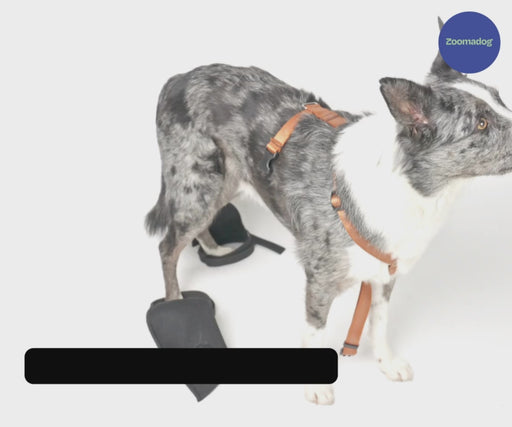
Harness: Make sure it is in the correct position. Importantly, the harness should not be on the shoulder joint. The shoulder joint should be able to move freely
Hip Brace (leg loops): Make sure the leg loops are nice and tight on your dog. You can always tighten the loops before you put the brace on your dog.
Hip brace (closing the brace): When your dog's legs are through the loops, fold the hip brace parts strongly over one another. Attach with the Velcro. The Velcro is there to hold the brace firmly in position. This will give your dog's hips strength and support.
Hip brace (position): Make sure the hip brace panels are covering the hip joint nicely. For larger breeds, you can close the hip brace in a position a little in front of the hips if you like.
Connect the Spine Strap to the harness: Again, the tension should be firm here, the harness will keep the hip brace in place


